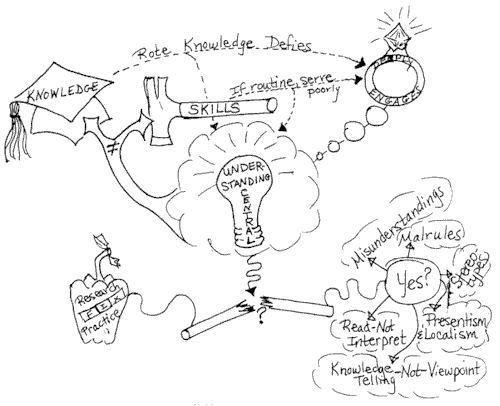
| Mind Maps"Mind mapping" is a strategy that encourages group members to
record ideas and connections among ideas in a visual form. It helps participants
understand the relationships among different concepts and ideas.
Directions:
Use the following mind map directions:
- The central topic or concept is noted in the center of the page.
- Important information is highlighted by bubbles, arrows or wavy lines.
- Color can be used to help members retain the ideas. It can also help
organize different concepts.
- Key words function as triggers that lead to additional, connected
ideas.
- Chains provide the connections or links to establish and create
relationships between ideas.
- Visuals such as illustrations, novel shapes, and pictorial details
facilitate retention.
Academic Task:
Work in your cooperative group on your assigned topic using the markers and chart
paper provided:
- Groups 1 & 2 - What is Understanding? & How Can Students Learn with
Understanding? (pp. 3-5)
- Groups 3 & 4- How Can We Teach for Understanding? (pp.5-7)
- Groups 5 & 6- What Should We Teach for Understanding?, What is Generative Knowledge?
& Powerful Conceptual Systems (pp.7 -9)
Roles:
Assume one of the following roles:
- Facilitator: Encourages participation.
- Materials manager: Collects necessary materials
- Map Checker(s): Ensures map has all component parts
- Scout: Scouts out ideas from other groups.
- Timekeeper: Monitors time.
Social Skill Focus:
Work carefully to listen during your collaborative conversation.
Accountability:
Team success depends on each of you being able to explain every aspect of your
team mind map. Sign your name to the map when you can do this - and are certain that your
partners can, too.
Individual Processing:
How helpful were you in accomplishing the team goal?

Why did you rate yourself as you did?
Would you do anything differently next time?
Small Group Processing:
What was the best thing about working with your teammates?
What adjustments might you make to fine-tune your collaborative efforts?
Copywrite: Michael Fullan, School Culture and the Change Process |